

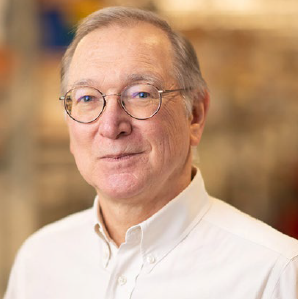
dR. gORDON FREEMAN
Gordon Freeman, Ph.D. is in the Department of Medical Oncology at Dana-Farber Cancer Institute and is Professor of Medicine at Harvard Medical School. Dr. Freeman earned his BA in Biochemistry and Molecular Biology, and PhD in Microbiology and Molecular Genetics from Harvard University.
Dr. Freeman’s research identified the major pathways that control the immune response by inhibiting T cell activation (PD-L1/PD-1 and B7-2/CTLA-4) or stimulating T cell activation (B7-2/CD28). In 2000, Dr. Freeman discovered PD-L1 and PD-L2, and showed they were ligands for PD-1, thus defining the PD-1 pathway and the drug target: block the interaction. He showed the function of PD-1 was to inhibit immune responses and that blockade enhanced immune responses. He showed that PD-L1 is highly expressed on many solid tumors such as breast and lung, as well as some hematologic malignancies and allows these tumors to inhibit immune attack. This work provided the critical translational insights for development of a successful strategy for cancer immunotherapy - blocking the PD-1-ligand interaction. More recently, he identified the B7-H7 (HHLA2)/KIR3DL3 pathway as an alternative immunoinhibitory pathway for cancer immune evasion.
Dr. Freeman has published over 400 scientific papers and is recognized by Thomson Reuters/Clarivate as a Highly Cited Researcher (top 1% in 2002-2025) and 2016 Citation Laureate. He is a member of the National Academy of Sciences, the American Academy of Arts and Sciences and is a Fellow of the AACR and SITC Academies. He holds over 98 US patents on immunotherapies and is a member of the National Academy of Inventors, He has received numerous awards including the 2014 William B. Coley Award for Distinguished Research in Tumor Immunology, 2017 Warren Alpert Foundation award, the 2020 Richard Smalley, MD, memorial award, the 2024 AACR-CRI Lloyd J. Old Award in Cancer Immunology, the 2024 David and Beatrix Hamburg Award for Advances in Biomedical Research and Clinical Medicine, and the 2025 Gretener-Thürlemann Prize for his work that led to development of PD-L1/PD-1 pathway blockade for cancer immunotherapy.